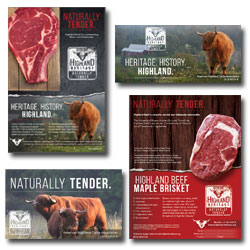
 The Skillet Beef Marketing Materials are fabulous new rack cards, brochures, posters and social media graphics using recipes and the latest tenderness research, which can be used and customized by all AHCA members. See the thumbnails for a few examples. Materials are available to AHCA members only by contacting the AHCA office.
Here are some tips to consider when building a business plan for your own farm, which will help determine your marketing objective.
Step one is to define your goal. There are two components in a goal. The first component is motivation, or why. This can include items like raising the animals for pleasure, for a lifestyle, to maintain land, to reduce taxes, to raise my own beef, to make money, or one of several other motivations. The second component is the market, or where your animals will end up. This can include, breeding stock, beef, pets or other markets.
The first component is acquiring an asset. We could acquire an asset by purchasing a cow, heifer, bull, semen, embryo, steer, or have an animal born to a current cow. Step two in applying a goal is to decide if you are going to retain an asset, or for how long you will retain an asset. Retaining an asset can include keeping a cow to produce a calf for another year, keeping a heifer as a replacement, castrating a bull and keeping it for a steer, or retaining a bull for another breeding season. In your implementation plan, you will want to decide how long you want to retain an asset.
Step three is to apply the retained asset. Applying an asset means putting it to work such as, breeding a cow/heifer, selling a bull for breeding, using a bull for breeding, or fattening a steer. Every time you retain an animal, you should be applying the animal towards your goal. If an animal is not being applied toward the goal, it should be addressed in the next step. The final step in implementing a goal is to redeploy an asset. Redeploying should occur when the asset is no longer meeting your goal when the asset is being applied. For example, a steer is ready to butcher at Windland Flats. This asset is done being applied and now must be redeployed as sellable meat products for consumers. Another example might be to sell a heifer calf, to use the money from the sale to improve infrastructure at your farm. You should be looking at your goal and evaluating redeployment continuously. One of the keys to evaluating cattle to decide if they are working for your goal is to have the right metrics in place to measure. We will address metrics later in this article.
There are many factors to consider when implementing the four steps of asset management in cattle. For thought starters, here is a list of factors you need to think about after setting your goal, but before purchasing your next cattle.
| Logistics | Management | External Factors |
| Location | Breeding | Availability |
| Size | Nutrition | Supply |
| Scale | Feed | Demand |
| Cost | Herd Health | Market Access |
| Labor | Record Keeping | Price |
Logistics consist of the elements related to the day-to-day implementation of owning and operating a cattle herd (fold). Your farm or ranch location may determine your ability to market you animals. For example, are you near a major metropolitan area, or a group of consumers looking for Highland beef. The number of acres, scalability and cost of entry are also things that will determine how you implement your goal. Labor can also make or break a lot of farms. Can you do it yourself and can you find good help?
Your ability to implement certain management practices, such as breeding, nutrition, feeding practices, heard health and record keeping will also influence your ability to execute your goal. For example, perhaps making hay is not your strong suit. Buying hay allows you to optimize your acres for pasture, rather than hay the ground. It also allows you to shift capital (money) to the purchase more cattle.
The biggest thing we cannot control is external factors such as the availability of animals, supply of beef (both domestic and imported), consumer demand for beef, demand for breeding stock or pets, market access and cattle prices. Though we cannot control them, we must address and plan for them.
Measurement is probably the area where farms and general businesses fail. We all are too busy implementing, and running as fast as we can toward the finish line to take a few minutes to measure how far to the finish line. Even worse is when we take the time to measure, but never fix or change future outcomes by our past learnings. Doing something over and over, yet never improving the result can make for a short-lived goal.
Metrics should be evaluated at minimum on a yearly basis. A good start is to look at your herd on a macro level, like total calving crop percentage, number of days to breed back, days on pasture and other herd level factors. In addition, each asset (animal) should also be measured for pre-determined metrics, based on your goal. Examples might be frame score, weaning weight, docility score, breed character or other measurements. Many of us already have these measurement factors in our mind, we just have not applied all of them to pen and paper.
Know What You are Selling It is more than just the product. It’s a bundle of valuable things that are appreciated by your target customers Know What You are Selling…
General Marketing Options and Recommendations The beef business is completely different from the cattle business. You will need a completely different mental paradigm to market beef to customers. You will…
Advertising and promotion are important for any ongoing business or service, even if you have significant good will and public recognition of your product or service. This is true for…